
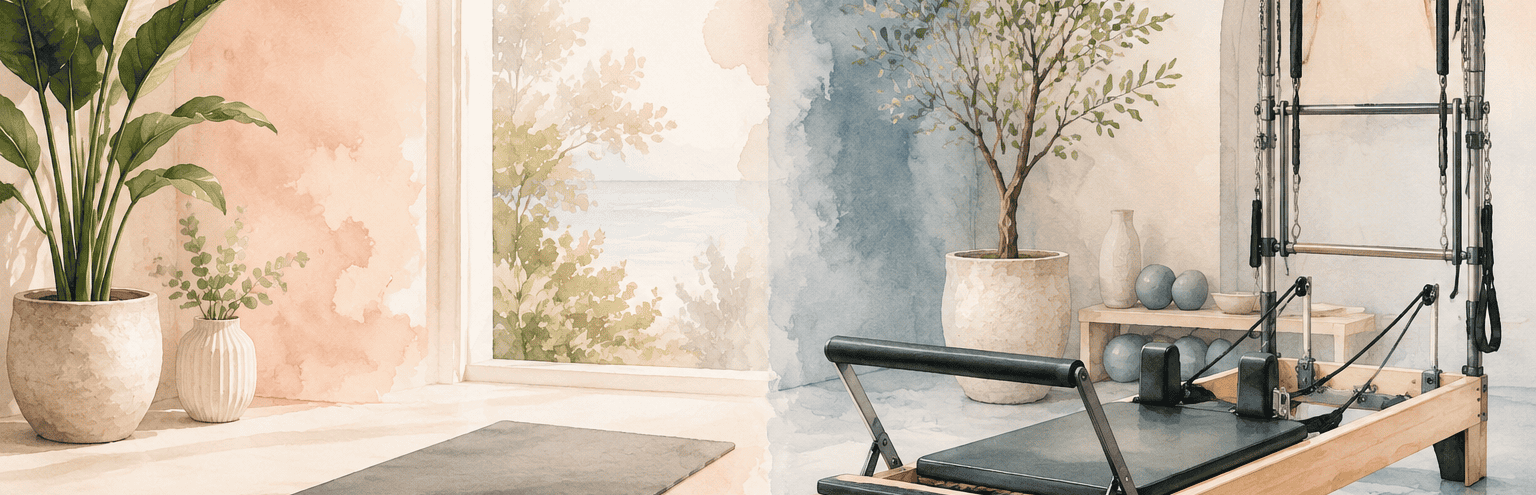
Quick Answer: Mat Pilates uses only your bodyweight and gravity to build strength, control, and body awareness — no equipment needed, and it can be done anywhere. Reformer Pilates uses a spring-loaded machine to either support or challenge movement, making it highly adaptable for rehabilitation, progressive loading, and variety. Both methods share the same core Pilates principles and deliver real results. The best choice depends on your goals, budget, access, and where you are in your movement journey.
Key Takeaways
- Mat Pilates is the foundation of the entire Pilates method — it builds raw core strength and body awareness because your body must supply all the control [2]
- The reformer was designed to support mat work, not replace it — Joseph Pilates never intended it to stand alone [2]
- Reformer springs work both ways: they can assist movement (making it easier) or add resistance (making it harder), so it suits all levels [1]
- Mat Pilates costs far less — all you need is a mat, and you can practise at home or join an affordable class
- Reformer Pilates is particularly helpful for injury rehabilitation and those with movement restrictions, thanks to adjustable resistance and physical support [3]
- Both methods share the same six principles: concentration, control, breath, centring, flow, and precision [3]
- A combined approach is considered optimal — mat teaches you to organise your body; reformer teaches you to apply that organisation under load [2]
- Hybrid studio models are growing in 2026, with clients combining in-studio reformer sessions and at-home mat work [4]
- Consistency matters more than which method you choose — regular practice of either will improve posture, core strength, mobility, and wellbeing
- Beginners can start with mat Pilates today with no equipment, no cost barrier, and no prior experience needed
What Is Mat Pilates and How Does It Work?
Mat Pilates is the original form of the method, performed on a padded mat using only your bodyweight and the resistance of gravity. It is widely recognised as the foundation of the entire Pilates system — and for good reason [2].
Because there is no machine to assist or guide you, your body must supply all the control and stability from within. That means your deep core muscles, your postural muscles, and your breath are constantly engaged. Every exercise asks you to move with control and build strength from the centre.
What to expect in a mat class:
- Exercises performed lying down, sitting, kneeling, or standing
- A focus on spinal alignment, core engagement, and breath
- Progressions that challenge balance, coordination, and endurance
- No equipment required (though small props like resistance bands or Pilates balls are sometimes used)
- Suitable for complete beginners through to advanced practitioners
Mat Pilates is gentle yet effective — and because it relies on your own body, it develops a deep sense of body awareness that carries into everyday movement. If you're beginning your Pilates journey, mat work is an excellent place to start.
What Is Reformer Pilates and How Is It Different?
Reformer Pilates is performed on a sliding carriage machine fitted with a spring resistance system. The springs can be adjusted to either assist movement (reducing the effort required) or add resistance (increasing the challenge) — which makes the reformer genuinely versatile across all fitness levels [1].
The reformer creates a very different movement experience from mat work. The sliding carriage provides feedback through your body, helping you feel alignment and control in a new way. It also allows a wider range of positions and exercise variations, including standing, kneeling, and lying work.
What makes reformer Pilates distinctive:
- Spring resistance that adapts to your needs and ability
- Physical support from the machine, which can reduce strain on joints
- A broader range of movement planes and positions
- Particularly well-suited to injury rehabilitation and mobility work [3]
- Typically taught in smaller group classes or 1-to-1 sessions due to equipment cost
"Mat teaches you to organise your body; reformer teaches you to apply that organisation under load." [2]
One important thing to understand: the reformer was originally created to improve and support mat work — not to serve as a more advanced or superior alternative [1]. This is a common misconception that leads many people to skip mat work entirely, which can leave gaps in strength and body control over time [2].
Mat vs Reformer Pilates: A Side-by-Side Comparison
Here is a clear breakdown to help you see the key differences at a glance.
| Feature | Mat Pilates | Reformer Pilates |
|---|---|---|
| Equipment needed | Mat only | Reformer machine |
| Cost to start | Low (mat from ~£20–£40) | High (machine £500–£3,000+) |
| Class cost (UK) | Typically £8–£15 per class | Typically £20–£40 per class |
| Suitable for beginners | ✅ Yes | ✅ Yes (with guidance) |
| Good for rehabilitation | ✅ Yes | ✅ Especially suited [3] |
| Can be done at home | ✅ Easily | ❌ Not without equipment |
| Resistance type | Bodyweight and gravity | Adjustable spring resistance |
| Core challenge | High — body supplies all control | Variable — springs can assist |
| Range of exercises | Broad | Very broad |
| Instructor guidance needed | Helpful but not essential | Strongly recommended |
Who Is Mat Pilates Best For?
Mat Pilates suits a wide range of people — and it's the most accessible way to start building low-impact strength and mindful movement habits.
Choose mat Pilates if you:
- Are new to Pilates and want to learn the fundamentals
- Prefer to practise at home without spending on equipment
- Want to connect breath and movement and build body awareness from the ground up
- Are on a budget — mat classes and free Pilates videos make it easy to get started
- Travel frequently and want a consistent practice you can take anywhere
- Enjoy group class energy and community
Mat Pilates is also ideal for those returning after illness or injury who want a gentle re-entry into movement. Because exercises can be adapted — lying, sitting, or standing — it truly is Pilates for everyone.
Common mistake: Assuming mat Pilates is "too easy" or just a stepping stone to the reformer. In reality, advanced mat work is extraordinarily challenging, and even experienced practitioners find it humbling. Progress over perfection applies here.
Who Is Reformer Pilates Best For?
Reformer Pilates is a brilliant option for people who want more variety, physical support during movement, or a structured environment for rehabilitation and progressive strength work.
Choose reformer Pilates if you:
- Are recovering from injury and need adjustable, supportive resistance [3]
- Want to explore a wider variety of exercises and movement planes
- Prefer the tactile feedback of working with a machine
- Are an athlete looking to complement performance training
- Want to deepen an existing Pilates practice with new challenges
- Enjoy 1-to-1 or small group sessions with close instructor attention
The adjustable spring system means the reformer can be made easier or harder depending on where you are on any given day — which is particularly valuable when managing pain, fatigue, or post-injury recovery.
Edge case: Some people find the reformer easier to engage with than mat work initially, because the machine provides physical feedback and support. If that's you, that's completely fine — just make sure mat work stays part of your practice too.
Mat vs Reformer Pilates: Do You Have to Choose?
No — and ideally, you shouldn't. The most well-rounded Pilates practice includes both [2].
Industry experts increasingly describe mat and reformer as collaborators, not competitors [2]. Mat work builds the foundational strength and body awareness that makes reformer work more effective. Reformer work then challenges that awareness under load and across a broader range of movement.
In 2026, many studios are embracing a hybrid model: clients attend in-person reformer sessions and complement that with at-home mat practice via online classes or studio apps [4]. This approach gives you community, accountability, and variety — without having to choose one method over the other.
If budget or access is a limiting factor, start with mat Pilates and build a consistent practice. You can always add reformer sessions later. Consistency matters far more than which method you choose.
How Much Does Each Method Cost in 2026?
Cost is one of the most practical factors in the mat vs reformer Pilates decision.
Mat Pilates costs:
- A quality Pilates mat: approximately £20–£50
- Group mat classes: typically £8–£15 per session in the UK
- Online mat classes: as low as £8.99 per month (such as the live online Pilates membership at Pilates Moves You)
- Free mat workouts: available on YouTube at no cost
Reformer Pilates costs:
- Studio reformer classes: typically £20–£40 per session
- Home reformer machine: £500–£3,000+ depending on quality
- 1-to-1 reformer sessions: often £50–£80+ per session
For most people, mat Pilates offers exceptional value. You can build real strength, better posture, and better balance without a significant financial commitment — especially when free Pilates videos and affordable online memberships are available.
If reformer classes appeal to you, consider booking a few 1-to-1 sessions to learn the machine properly before joining group classes. This investment in good technique pays off quickly.
What Results Can You Expect from Each Method?
Both mat and reformer Pilates produce real, meaningful results — and both operate through the same six core principles: concentration, control, breath, centring, flow, and precision [3].
With consistent mat Pilates practice, you can expect:
- Stronger deep core muscles and improved spinal stability
- Better posture and reduced back pain
- Increased flexibility and joint mobility
- Improved body awareness and coordination
- Calmer mind and reduced stress — many practitioners describe their weekly class as a mental reset as much as a physical one
With consistent reformer Pilates practice, you can expect:
- All of the above, plus
- Greater variety in movement and exercise selection
- Stronger functional strength through spring-loaded resistance
- Improved proprioception (your sense of where your body is in space)
- Particularly strong results for rehabilitation and injury recovery [3]
The honest truth? Both methods work. The results you get depend far more on how regularly you practise and how mindfully you move than on which piece of equipment you use — or don't use.
How to Get Started with Mat or Reformer Pilates
Starting with mat Pilates:
- Roll out a mat at home and explore free Pilates videos to learn the basics
- Join a beginner-friendly group class — small class sizes mean you get personal attention and real guidance
- Build a consistent weekly habit before adding complexity
- Progress to intermediate mat work as your strength and confidence grow
Starting with reformer Pilates:
- Book a 1-to-1 introductory session so an instructor can show you how to use the machine safely
- Start with lighter spring resistance — the reformer is not about pushing harder, it's about moving better
- Combine reformer sessions with mat practice at home to reinforce what you learn
If you're based in or near South Manchester, in-person group Pilates classes in Heaton Moor offer a warm, supportive environment for all levels. Private 1-to-1 sessions are also available for those who want a fully personalised programme.
Conclusion: Which Is Right for You?
The mat vs reformer Pilates question doesn't have a single right answer — it has a right answer for you, right now.
If you're new to Pilates, working with a limited budget, or want to build a practice you can do anywhere, start with mat Pilates. It is the foundation of the method, it costs almost nothing to begin, and it will challenge you far more than you might expect.
If you have access to a reformer studio, are recovering from injury, or want to add variety and progressive resistance to an existing practice, reformer Pilates is a wonderful complement — not a replacement for mat work, but a powerful addition to it.
And if you can do both? Even better.
Your next steps:
- Try a free mat Pilates video today — no equipment, no commitment, just movement
- Explore the Pilates services available at Pilates Moves You, from online classes to in-person sessions in Heaton Moor
- If you have questions about which option suits your goals, get in touch — there's always a friendly, expert answer waiting
Every Pilates journey starts with a single session. Feel stronger every day — one mindful movement at a time.
Frequently Asked Questions
Is mat Pilates harder than reformer Pilates? Mat Pilates can actually be more challenging for core strength because your body must supply all the stability without mechanical support. The reformer's springs can assist movement, making some exercises easier. Neither is universally harder — the difficulty depends on the exercise, the resistance setting, and your experience level.
Can a complete beginner do reformer Pilates? Yes, but it's strongly recommended to start with a 1-to-1 or small group session so an instructor can teach you how to use the machine safely. The adjustable resistance makes it accessible for beginners, but proper guidance prevents poor habits forming early on.
Do I need to learn mat Pilates before trying the reformer? It's not a strict requirement, but learning mat Pilates first gives you a strong foundation in core engagement, breath, and alignment — which makes reformer work more effective and safer. Many instructors recommend starting with mat basics before progressing to the machine.
How often should I practise Pilates to see results? Most people notice meaningful improvements in posture, core strength, and mobility within four to six weeks of practising two to three times per week. Consistency matters more than frequency — one or two quality sessions per week, done regularly, will serve you better than sporadic intense training.
Is reformer Pilates good for back pain? Yes. The adjustable resistance and physical support of the reformer make it particularly suitable for people managing back pain or recovering from spinal injuries. That said, mat Pilates is also highly effective for back pain when exercises are properly adapted. Always inform your instructor of any existing conditions before starting.
Can I do mat Pilates at home without an instructor? Yes — mat Pilates is well-suited to home practice, especially with quality video guidance. Free and low-cost online classes make it easy to build a consistent home practice. Beginners benefit from at least a few guided sessions first to learn correct technique and avoid reinforcing poor movement patterns.
What equipment do I need for mat Pilates at home? A good-quality Pilates mat is the main requirement. Some classes occasionally use a small resistance band, a Pilates ball, or light hand weights — but household alternatives (a belt, a cushion) often work just as well.
Is reformer Pilates worth the extra cost? For many people, yes — especially for rehabilitation, progressive strength training, or adding variety to an established practice. However, mat Pilates delivers excellent results at a fraction of the cost. The value of reformer sessions depends on your goals and how regularly you can attend.
Are mat and reformer Pilates good for weight loss? Both methods support body composition changes over time by building lean muscle, improving posture, and increasing overall activity. Neither is a high-calorie-burn workout in the traditional sense, but both contribute to a stronger, more functional body — which supports long-term health and wellbeing.
How do I know which Pilates class is right for me? Consider your goals (core strength, rehabilitation, flexibility, variety), your budget, and your access to equipment. If you're unsure, start with a beginner mat class — it's the lowest barrier to entry and gives you a clear sense of whether Pilates is right for you before investing in reformer sessions.
References
[1] Watch - https://www.youtube.com/watch?v=eSN3cwoY2_w
[2] Reformer Pilates Vs Mat Pilates - https://www.prevention.com/fitness/a69780294/reformer-pilates-vs-mat-pilates/
[3] Reformer Vs Mat Pilates - https://www.healthline.com/health/reformer-vs-mat-pilates
[4] Pilates In 2026 De Trends Ontwikkelingen - https://depilatesstore.nl/en/blogs/kennisbank/pilates-in-2026-de-trends-ontwikkelingen
[5] Pilates Trends Defining The Next Chapter Of The Industry - https://www.merrithew.com/blog/post/2026-02-20/pilates-trends-defining-the-next-chapter-of-the-industry